Yuzu now turns up in American kitchens, from sauces to desserts and drinks, thanks to a fragrance that comes with its acidity. But its story begins in Asia, long before these contemporary uses: a fruit of Chinese origin that became a familiar ingredient in Japanese cooking.
That journey combines culinary culture, the movement of plants and the work of botanical collections. To identify the tree and its fruit, see the classic yuzu profile. This article traces its history; planting advice is in the yuzu growing guide.
Where does yuzu come from? A Chinese origin, a Japanese adoption
Yuzu (Citrus × junos) is of Chinese origin, and its cultivation developed widely in Japan. The University of California, Riverside describes it as a citrus of hybrid origin, related to the papedas and the mandarins.
A precise botanical record lets us follow its movement: the Riverside collection holds a yuzu grown from seed that Frank Meyer collected in Hubei, China, and that reached the collection in 1918. This documented accession does not date the birth of yuzu, but it shows that the fruit was already being studied outside Asia long before its recent culinary success.
Japan made it an especially important seasoning fruit. JETRO highlights the role of its zest and juice in cooking. It is generally not eaten like an orange: what cooks seek is mainly the aroma a small amount brings to a dish.
How did yuzu take root in Japanese culture?
Yuzu goes into savory dishes as readily as drinks and desserts. Its zest can scent a broth or a condiment; its juice adds acidity to a sauce. That place in the kitchen helps explain why a seedy, relatively dry fruit remains so prized.
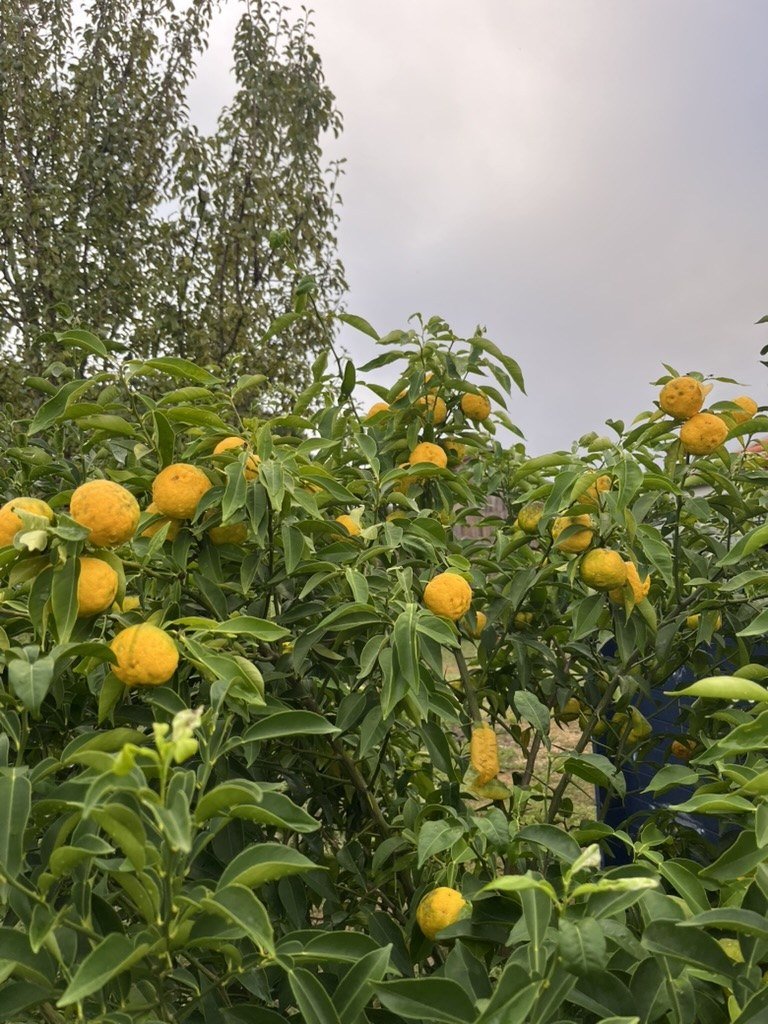
Japan distinguishes green yuzu, called aoyuzu, from the fruit once it has turned yellow, kiyuzu. JETRO describes these two seasonal forms: green from summer into fall, yellow from fall onward. These periods describe the Japanese market; they do not set the harvest date in an American garden.
The fruit is therefore valued at several stages. You might look for a hint of zest in a dish rather than a tall glass of juice: yuzu is first a matter of dosage and pairings.
How did yuzu travel beyond Asia?
The history of botanical collections and that of everyday eating move at different speeds. In 1914, Frank Meyer, a plant explorer for the USDA, found yuzu growing wild in southern Gansu, China, and sent seed back to the United States. According to the Riverside collection, the botanist Tanaka found in 1922 that this plant was identical to a yuzu the USDA had already kept in its greenhouses for several years. The same source reports the hypothesis that Japanese immigrants brought yuzu to the United States before 1900 for their own gardens. These records contradict the idea of a fruit entirely unknown in America until recent decades.
A tree kept in a collection does not automatically become a fruit available at the grocery store. That takes production, outlets and culinary uses that buyers understand. The growth of culinary exchange has given yuzu new chances to be tasted.
Japanese exports form a documented chapter of that spread. JETRO reports that the village of Kitagawa, in Kochi Prefecture, expanded its yuzu exports within a few years to more than 25 countries, including the United States, and that Tokushima Prefecture also exports to the United States. These milestones are firmer reference points than a supposed date of “discovery” by a single chef.
How did yuzu find its way into American kitchens?
Yuzu offers another way to work with acidity: its juice brightens a sauce, while its zest brings a distinct fragrance. A lemon recipe can thus become a starting point for experiments, though the two fruits are not interchangeable in equal amounts.
Two sources give concrete markers of this interest. JETRO notes that chefs in New York, as in Paris, have in recent years been using yuzu in pasta, sautéed dishes and desserts for its distinctive fragrance. The Riverside collection observes that in the United States yuzu is used much like lemon, since it is highly acidic.
These uses show how the fruit fits into American cooking while keeping a link to Japanese ingredients. They do not prove that any particular chef was the first to use it, nor that every professional had ignored it before.
In the garden, the same curiosity can continue: growing a tree lets you explore the fresh fruit, its peel and the differences between a green and a yellow harvest. This option, however, requires choosing a growing method suited to the climate.
What role do citrus collections play in the United States?
In Riverside, California, the Givaudan Citrus Variety Collection holds about 4,500 trees of nearly 1,100 cultivars and species of citrus and related plants. The collection was started in 1910 by staff of the Citrus Experiment Station and USDA researchers. Alongside yuzu, it keeps separate accessions named Citrus hanayu and Citrus yuko. Preserving this diversity makes it possible to study and distribute plant material.
That work does not stop at the collection. The Riverside record for yuzu states that it is commercially available in California through the Citrus Clonal Protection Program, a cooperative program led by UC Riverside with UC Agriculture and Natural Resources, the California Department of Food and Agriculture, USDA-APHIS, California citrus nurseries and growers. It is preservation and research work that matters for all citrus.
A trade name such as Corsican Yuzu does not, on its own, prove a specific breeding program or the story of a selection by Japanese researchers. Documented institutional facts should be kept separate from the history of each plant offered for sale.
Likewise, Yuzu N3 names a horticultural selection whose precise origin remains to be documented. Its profile keeps a cautious benchmark near 5°F (−15°C) for a well-established mature tree, without treating it as a universal record or a guarantee of a harvest.
Which yuzu varieties can you grow in the United States?
The classic yuzu is the starting point for understanding the tree, the fruit and its uses. Named selections should then be compared according to the characteristics of the plant actually offered: propagation method, rootstock and the grower’s information.
- Yuzu N3: a distinct selection, to compare with the classic type without generalizing its hardiness claims.
- Gold Yuzu and Corsican Yuzu: plant names to examine separately.
- Yuzu Citron: a name proposed by Vessières for a yuzu with a lemony aroma; it does not prove a cross with lemon.
The yuzu and papeda collection lets you continue the comparison. The names Hana Yuzu or Oni Yuzu should not automatically be equated with classic yuzu: a common name can cover a different botanical identity.
How do you grow your own yuzu in the United States?
First choose between a container that winters under shelter and planting in the ground. The answer depends on the freezes you observe, how long they last, your soil and the protection you can provide. A suitable rootstock can help, but on its own it guarantees neither a minimum temperature nor a harvest.
To move from wanting a tree to planting one, see the guide to growing yuzu in containers and in the ground: site, watering, care, winter and harvest. The yuzu profile presents the botanical reference points and the hardiness indications with their conditions.
From culinary heritage to the garden
Yuzu connects several kinds of curiosity: preserving a plant in a collection, discovering its fragrance in a kitchen and trying to grow it at home. Its path is not that of a fruit suddenly invented by American cuisine; it is that of an Asian citrus whose uses have traveled.
A yuzu tree can extend that discovery into the garden, provided you choose a site and a growing method that suit it. To compare its uses with those of other Japanese fruits, continue with the yuzu, sudachi and kabosu comparison.
Updated October 18, 2026. Links in the text lead to the botanical collections, public agencies and producers cited.
Cover image: AI-generated illustration.