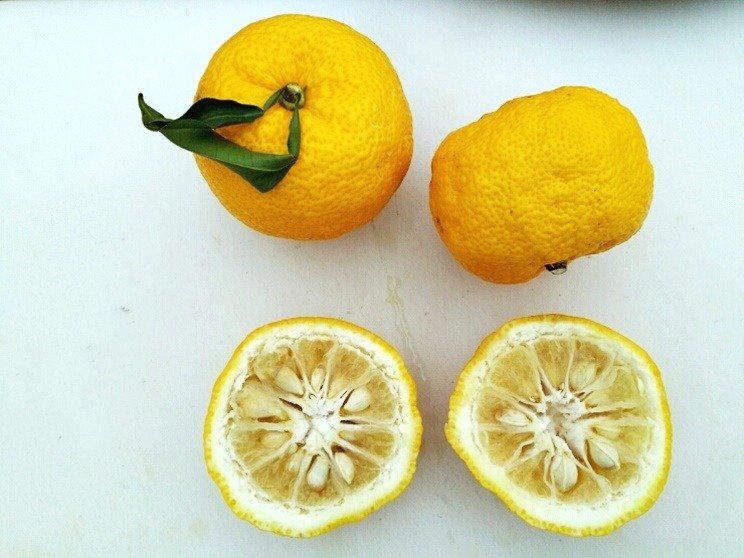
Identity
History & Description
The adult tree has a compact bushy habit, reaching 5 to 8 ft (1.5 to 2.5 m) in height and 3 to 5 ft (1 to 1.5 m) in width, which makes it one of the yuzus best suited to small gardens and to growing in a large container. The evergreen foliage carries the winged petioles typical of the genus, and the branches are fitted with the characteristic sharp thorns. The white, fragrant spring bloom gives, in November and December, bumpy golden yellow fruits of 2.8 to 4.2 oz (80 to 120 g), with thick skin rich in essential oils and an exceptionally aromatic zest: floral mandarin notes, resinous freshness, sharp acidity, and a Corsican signature more delicate than the German selections.
In the kitchen, the Corsican Yuzu is prized for its zest grated into pastries (tarts, ganaches, sorbets), for its juice in ponzu sauce and fish marinades, and for unique aromatic jams. It is viable in the ground across the whole southern half of France and the Atlantic coast (USDA zones 8a to 9b), grafted onto Poncirus trifoliata, against a south-facing wall with winter mulch. Available in France through the Quissac nursery (Mas Saint-Antoine) and a few specialist nurseries, it is for gardeners looking for an authentic piece of French citrus heritage.
Updated:
What matters when choosing
Key points about Corsican Yuzu
Yuzu de Corse is a selection from seedlings monitored at the Corsican citrus conservatory. Its appeal lies primarily in intensely fragrant peel, complex acidic juice, and documented selection; like other yuzus, it contains many seeds.
Why choose it
- Intensely fragrant zest rich in essential oils.
- Complex acidic juice suited to cooking.
- Selection associated with the Corsican citrus conservatory.
Its limits
- Many seeds and little juice per fruit.
- Thorny branches.
- Widely varying published cold thresholds.
Practical notes
- Origin
- Seedling selected in Corsica
- Harvest
- October through December
- Uses
- Zest, juice, marmalade
Cold-hardiness reference: about 9°F (−13°C)
Catalogs publish varying thresholds according to conditions; the reference concerns a mature, acclimated tree without guaranteeing a crop after freezing.
Sources and method
The temperatures given are reference points for a mature tree with hardened wood. The table and callout repeat the same value as the profile. They guarantee neither freedom from damage nor a harvest after a freezing event.
Data reviewed on September 21, 2026.
- Jardin écologique — Yuzu Corse — Selection history, fruit, seeds, and uses
- Verger Nature — catalog — Cultivar identification and reported horticultural threshold
- GenDep19 — cultivar table — Harvest, rootstocks, and a cautious cold-hardiness reference