
Identity
History & Description
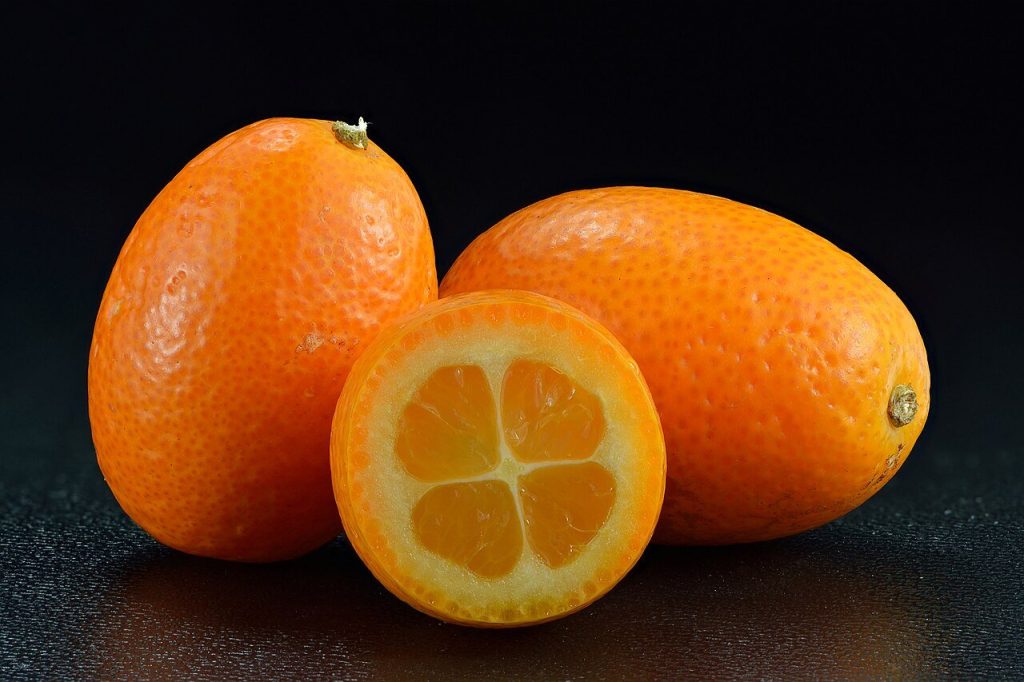
The tree forms a dense, bushy shrub generally reaching 7 to 10 ft (2 to 3 m) in cultivation, and up to 13 ft (4 m) in the ground depending on climate and rootstock, more compact in container culture (3 to 7 ft, or 1 to 2 m). Its evergreen, dark green, glossy foliage is very decorative and bears small, fine thorns. The late spring and summer flowering, white and delicately fragrant, gives bright orange oval fruits, measuring 1.2 to 1.6 in (3 to 4 cm) long, which ripen from November to February. The thin, sweet skin and the tart flesh are bitten into together — this is the signature taste experience of kumquats: a paradoxical contrast between outer sweetness and inner acidity.
In the kitchen, Nagami is one of the most versatile kumquats: jam, marmalade, candied kumquats, syrups, liqueurs (notably the famous Greek liqueur made from Corfu Nagami kumquats), confectionery, or simply eaten whole. It is viable in the ground throughout the southern half of France and the Atlantic coast (USDA zones 8a to 9b), grafted onto Poncirus trifoliata or Flying Dragon, against a south-facing wall with winter mulching. Excellent in a large container on a terrace, it is also one of the kumquats most widely distributed in mainstream French garden centers, which often makes it the introductory hardy citrus for amateur gardeners.
Hardiness — October 8, 2026 review: Retained reference of 10°F (−12°C), announced for Nagami by Agrumes de Provence. UF/IFAS also gives about 10°F (−12°C) for the kumquat group, in the Florida context; this general indication is not a trial of the plant you buy. These temperatures concern an adult, established, acclimated tree during an isolated freeze; they guarantee neither the absence of damage nor the harvest. Wind, freeze duration, humidity, and pot culture change the risk.
Fruit resistance: The fruit reference already recorded remains indicative: this review did not establish a new experimental threshold specific to this material. It is not deduced from the tree's temperature.
Hardiness references: Agrumes de Provence — Nagami; UF/IFAS — Kumquat (accessed October 8, 2026).
Updated:
What matters when choosing
Key points about Nagami Kumquat
Nagami is the classic oval-fruited kumquat: its peel is sweet and its pulp distinctly acidic, which gives the best balance when the fruit is eaten whole. Productive and relatively cold-resistant, it also works very well in preserves and as candied fruit.
Why choose it
- Good balance between sweet peel and acidic pulp.
- Productive tree well suited to container growing.
- Hardier than many fresh-eating citrus types.
Its limits
- Pulp is too acidic if eaten alone.
- Usually a few seeds.
- Fruit may be damaged before the wood suffers.
Practical notes
- Shape
- Oval and elongated
- Harvest
- Winter to early spring
- Uses
- Whole fruit, candying, preserves
Cold-hardiness reference: about 10°F (−12°C)
The selected reference is 10°F (−12°C), reported for Nagami by Agrumes de Provence. UF/IFAS also gives about 10°F (−12°C) for kumquats as a group in the Florida context; that general guidance is not a trial of the plant being purchased.
Sources and method
The temperatures given are reference points for a mature tree with hardened wood. The table and callout repeat the same value as the profile. They guarantee neither freedom from damage nor a harvest after a freezing event.
Data reviewed on October 8, 2026.
- Givaudan Citrus Variety Collection — UCR — Shape, flavor, seeds, season, and tree behavior
- UF/IFAS — Kumquat — General hardiness, uses, and cultivar comparison
- UF/IFAS — Florida Citrus Varieties — Season, acidity, seeds, and relative hardiness
- Agrumes de Provence — Nagami — Commercial claim of 10°F (−12°C) for Nagami.