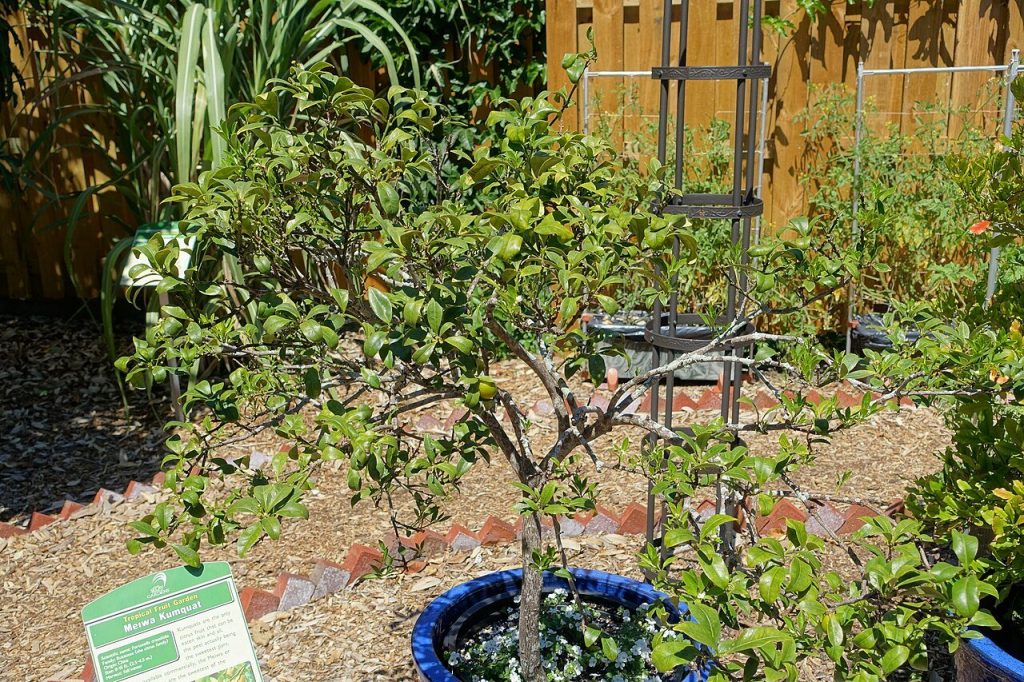

Identity
History & Description
Origin
Meiwa kumquat is an old variety from China, introduced to Japan in the Meiji era. Many consider it the best kumquat for fresh eating, often nicknamed the 'sweet kumquat'.Tree description
The tree is small and slow-growing, with a bushy habit and thick leaves, slightly smaller than those of the Nagami. It is robust and adapts well to small spaces.Fruit quality
Its fruits are round, sometimes slightly flattened, of medium size. The skin is thick, tender, and very aromatic, a deep orange when fully ripe.Flavor and ornamental interest
It is the eating kumquat par excellence. Its flavor is markedly milder than that of the other varieties, with sweet flesh and very little acidity. It is eaten whole like a treat.Hardiness — October 8, 2026 review: The reference is set at 10°F (−12°C) based on Agrumes de Provence. Listings range from 12°F (−11°C) at Aux Soleils de Manan to 7°F (−14°C) at Vessières. The latter figure is a nursery claim, not a guaranteed threshold. UCR historically reports a slightly lower resistance than Nagami, with no absolute figure. These temperatures apply to a mature, established, acclimated tree during a one-off frost; they guarantee neither the absence of damage nor a harvest. Wind, freeze duration, humidity, and pot culture change the risk.
Fruit resistance: The fruit reference of 25°F (−4°C) is kept: Aux Soleils de Manan advertises 25°F (−4°C), Vessières 23°F (−5°C). These figures concern the fruit, not the survival of the tree.
Hardiness references: Agrumes de Provence — Meiwa; Agrumerie Vessières — Meiwa; Aux Soleils de Manan — Kumquats et hybrides; UCR — Meiwa CRC 1471 (accessed October 8, 2026).
Updated:
What matters when choosing
Key points about Meiwa Kumquat
Meiwa is the kumquat to favor for fresh eating: its round fruit has a thick, sweet peel, less acidic pulp, and generally few seeds. Hardiness claims vary by grower; the selected reference is placed in context below.
Why choose it
- Sweet flavor suited to eating the fruit whole.
- Thick, sweet, aromatic peel.
- Generally few seeds.
Its limits
- Hardiness claims vary; protect the fruit separately from the tree.
- Slow growth and sometimes limited availability.
- Small fruit despite its rounded shape.
Practical notes
- Shape
- Round to slightly oval
- Harvest
- Late winter
- Use
- Whole fruit
Cold-hardiness reference: about 10°F (−12°C)
The selected reference is 10°F (−12°C), following Agrumes de Provence. Claims range from 12°F (−11°C) at Aux Soleils de Manan to 7°F (−14°C) at Vessières. The latter is a nursery claim, not a guaranteed threshold. UCR historically reports slightly lower resistance than Nagami without an absolute temperature.
Sources and method
The temperatures given are reference points for a mature tree with hardened wood. The table and callout repeat the same value as the profile. They guarantee neither freedom from damage nor a harvest after a freezing event.
Data reviewed on October 8, 2026.
- Givaudan Citrus Variety Collection — UCR — Fruit, flavor, seeds, season, and relative hardiness
- UF/IFAS — Kumquat — Meiwa–Nagami comparison and cultivation
- Mississippi State University Extension — Flavor, shape, and container growing
- Agrumes de Provence — Meiwa — Commercial claim of 10°F (−12°C) for Meiwa.
- Agrumerie Vessières — Meiwa — Commercial claim of 7°F (−14°C) for the tree; fruit described as sensitive around 23°F (−5°C).
- Aux Soleils de Manan — kumquats and hybrids — Claims: Meiwa 12°F (−11°C), Nameiwa 10°F (−12°C), their fruit 25°F (−4°C); Orangequat 18°F (−8°C).