Identity
History & Description
Origin
Shiranui, better known by its protected trade name "Dekopon" (デコポン), represents the culmination of several decades of Japanese varietal selection and is, in the eyes of many pomologists, the perfect citrus. It was obtained in 1972 at the Minamishimabara agricultural station, in Nagasaki Prefecture, by crossing the Kiyomi tangor (itself from the Satsuma Miyagawa × Trovita cross made in 1949, then registered in 1979) with the Ponkan mandarin (Citrus reticulata) of Chinese origin, known for its intense fragrance. Marketed from 1991 under the registered trademark "Dekopon" — a contraction of "deko" (bump) and "pon" (from Ponkan) — it has been the most widely grown citrus in Japan since 2015, an absolute symbol of Japanese know-how in hybridization. Outside Japan, it is marketed as "Sumo Citrus" in the United States and "Shiranuhi" in Korea, with regional variants such as 'Subarashi' or 'Shiranui Satsuma' designating slightly different clonal selections. Its hardiness, improved by grafting onto Poncirus trifoliata according to Japanese tradition, allows it to be grown in zone 8a with winter protection early in life.Tree description
Dekopon forms a vigorous tree of 10 to 13 ft (3 to 4 m) at maturity, with a semi-upright habit and evergreen foliage of an intense, glossy green. Growth is moderate but regular, and the tree proves very productive from its fifth year. The spring bloom is abundant and fragrant, and continues in successive waves. Its hardiness reaches 12°F (−11°C) on Poncirus trifoliata rootstock according to data from specialized nurseries, and 18 to 16°F (−8 to −9°C) on FA5 rootstock, which justifies its ranking among the tangors best suited to USDA zone 8a.Fruit quality
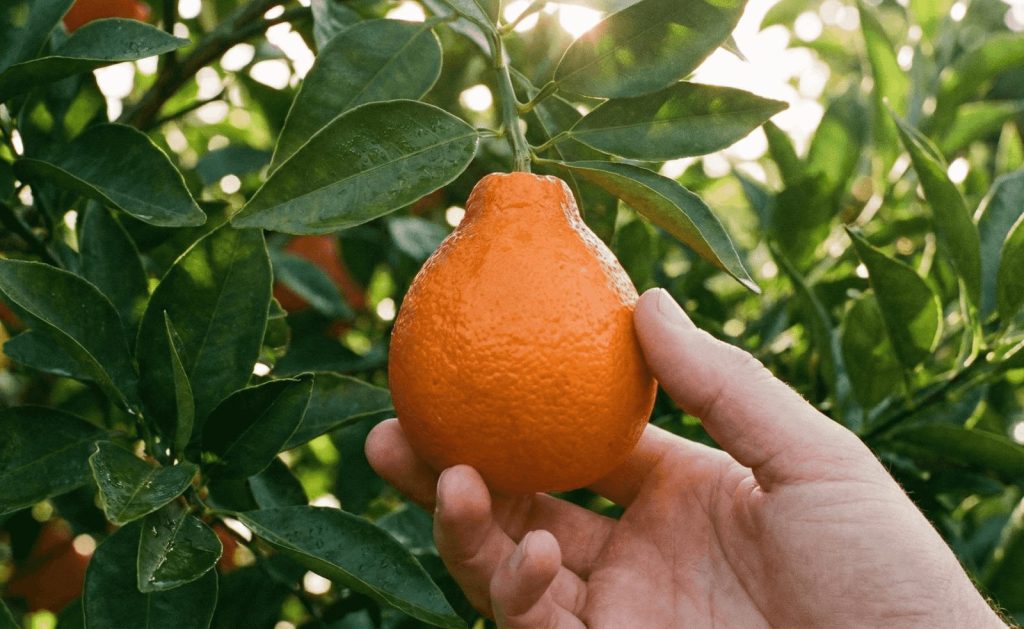
The exceptional fruit, weighing 7.1 to 10.6 oz (200 to 300 g), stand out for their characteristic apical bump that gave them their trade name, a genetic testament to the Ponkan parent. The flesh, completely seedless, is particularly tender, melting, and rich in juice, offering a flavor of rare complexity: an almost candied sweetness (Brix regularly exceeding 14°), minimal acidity, and floral notes evoking ripe mandarin and orange blossom. The skin comes off easily despite its thickness, and the highly fragrant zest recalls traditional candied peel.Flavor and ornamental interest
According to several French nurseries, the fruit can ripen as early as November in a sheltered position and stay on the tree until May-June; in Japan, NARO places typical maturity between mid-February and early March, a period during which they concentrate their aromas even more — a traditional Japanese practice called "hanjuku." Eaten fresh, Dekopon is considered one of the best table citrus in the world, offering the rare singularity of releasing its juice not at the cut but only in the mouth. Its premium price in Japan (several euros per fruit) reflects its rarity and quality. Ornamentally, the elegant silhouette of the tree and the prolonged presence of its large yellow-orange fruit make it an exceptional collection specimen, a living witness to Japanese horticultural excellence.Updated:
What matters when choosing
Key points about Dekopon (Shiranui)
Shiranui, often sold under brands such as Dekopon, is a large Japanese citrus with very sweet, juicy, easy-to-peel fruit. It needs a long, warm season to balance its acidity, however, which limits it to sheltered situations or container growing in cold regions.
Why choose it
- Very sweet, richly aromatic fruit when fully ripe.
- Thick but easy-to-remove peel.
- Large fruit and few seeds in favorable conditions.
Its limits
- Late maturity in Japan, often February through March.
- Persistent acidity if the fruit receives insufficient warmth.
- Tree sensitive to cold and some growing disorders.
Practical notes
- Parentage
- Kiyomi × Ponkan
- Typical weight
- Around 8 oz (230 g)
- Harvest in Japan (NARO)
- February through March
Cold-hardiness reference: about 12°F (−11°C)
The figure is a protection reference, not a promise of a harvest: the fruit ripens late and is vulnerable to freezing well before the wood.
Sources and method
The temperatures given are reference points for a mature tree with hardened wood. The table and callout repeat the same value as the profile. They guarantee neither freedom from damage nor a harvest after a freezing event.
Data reviewed on October 7, 2026.
- NARO — Shiranui — Origin, size, sweetness, acidity, season, and tree behavior
- Japan’s Ministry of Agriculture — Cultivation and harvest period in Japan
- NSW Department of Primary Industries — Parentage and fruit characteristics