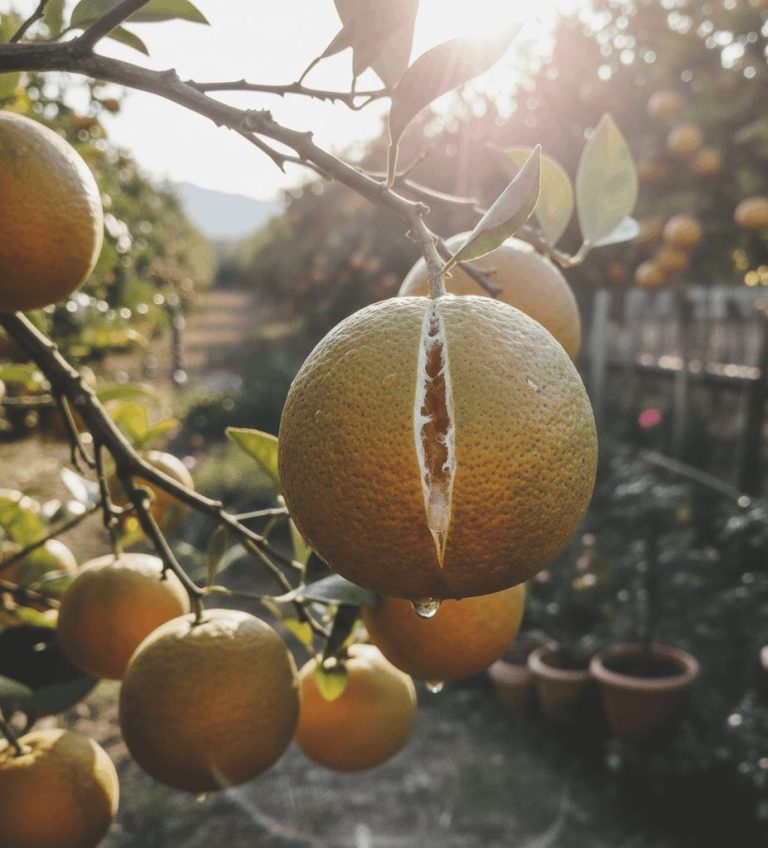
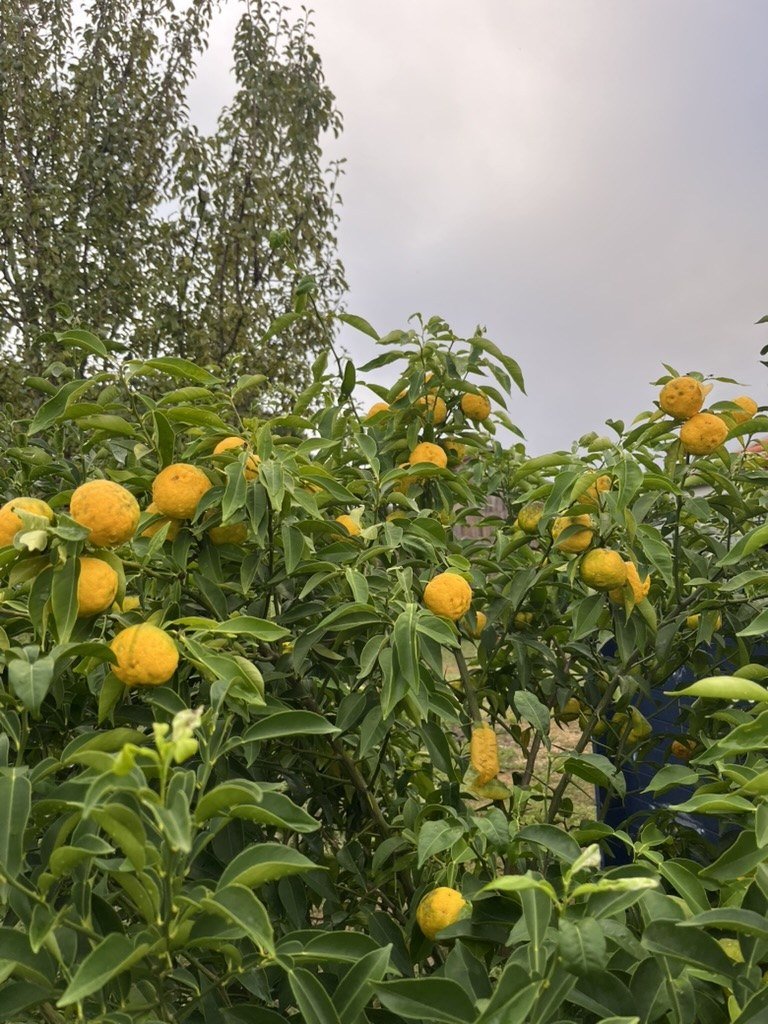
Eremorange is a horticultural hybrid reported as Citrus glauca × sweet orange (Citrus × sinensis). Its parent Citrus glauca, the desert lime, is indeed an Australian species adapted to water deficit and relatively tolerant of cold. However, the sources consulted do not make it possible to establish with the same level of proof that every Eremorange sold was created in Australia, or to set a universal threshold of 10°F (−12°C) or 5°F (−15°C) for the hybrid. It is a promising collector’s citrus, to be bought and grown as an identified accession, not as a guaranteed “hardy orange.”
This article therefore adds an important nuance to the expression “Australian hybrid”: the Australian ancestry is established; the precise origin of the hybrid sold under the name Eremorange is not, here.
A simple genealogy, a less simple horticultural identity
The announced parentage is consistent from one source to another: a sweet orange crossed with the desert lime. Our Eremorange profile also carries this parentage, as Citrus glauca × Citrus sinensis.
The name of the Australian parent deserves a clarification. Modern literature uses Citrus glauca; Eremocitrus glauca remains a very common name in horticulture. The scientific review devoted to Australia’s native citrus explains that the former genera Microcitrus and Eremocitrus have been merged into the genus Citrus [1].
On the other hand, “Eremorange” does not appear, in the sources examined, as the name of a cultivar with a breeding record or a single traceable genealogy. Independent catalogs do use it for Citrus sinensis × Citrus glauca [2][3], but their accounts differ on the origin of the cross. The attribution to Australia’s CSIRO, sometimes repeated, was not confirmed by a scientific publication or a cultivar register found for this article.
Practical consequence: ask the nursery for the clone, the origin of the scion, and the rootstock. Two plants labeled Eremorange are not necessarily strictly comparable material.
What the desert lime really contributes
Citrus glauca is endemic to semi-arid regions of Queensland, New South Wales, and South Australia [4]. This is the solid foundation of the story: the Australian ancestry of Eremorange is not in doubt.
The desert lime is also a remarkable case among citrus: recent work describes it as a xerophyte, with adaptations to water shortage — a well-developed root system, a thick cuticle, sunken stomata, and the ability to drop its leaves while maintaining photosynthesis through its twigs [1][4]. It is therefore a logical resource for breeding programs seeking greater water-use efficiency.
But an inheritance is not an equivalence. A first-generation hybrid can pass on some, but not all, of the wild parent’s characteristics. Soil, rootstock, the age of the plant, and fruit load also change the response to drought considerably.
Drought: a possible tolerance, not an exemption from watering
For Citrus glauca, tolerance of water deficit is supported by several independent academic sources [1][4]. For Eremorange itself, the available data are mostly horticultural descriptions rather than published comparative trials. It is therefore more accurate to speak of a potential for better dry-weather tolerance inherited from C. glauca than of demonstrated resistance to prolonged drought.
In practice:
- plant in deep soil that drains but can hold a little water;
- water regularly during establishment, at least for the first seasons;
- avoid both a dried-out root ball and roots that are suffocated for long periods;
- in a pot, never carry over the reputation of the desert parent: the limited volume of substrate calls for close monitoring.
The guide Citrus in Summer: Watering and Extreme Heat details why a citrus, even one adapted to a dry climate, quickly suffers from swings between drought and overwatering in cultivation.
Cold: encouraging indications, but no universal threshold
Cold is the point on which the labels differ most. Some commercial listings credit Eremorange with 10 to 5°F (−12 to −15°C) [3]. A collection trial conducted in an unheated cold greenhouse in the Czech Republic reports no observed damage on one Eremorange plant after a night measured at 14°F (−9.8°C); the author explicitly describes a greenhouse setting, a given plant material, and an isolated observation [5]. This is interesting information, not a planting standard.
The scientific references are firmer for the parent Citrus glauca than for the hybrid. A 2025 review gathers observations of C. glauca ranging from moderate frosts to lower temperatures; it puts its real order of magnitude at around 14°F (−10°C) and reminds readers that the fruits are not hardy. It also cites C. glauca hybrids that survived 19°F (−7.2°C) and 14°F (−10°C) in separate trial settings [1]. A genomic study confirms the potential for transmitting cold-tolerance traits, without providing a threshold specific to Eremorange [4].
The cautious benchmark currently retained by the site for the profile is about 18°F (−8°C), precisely because the listings are not comparable between clones or between situations. It is not a promise of survival or of a harvest; it is a caution threshold for deciding when to protect.
The conditions that change everything
Before concluding that a plant “holds” a given temperature, note:
- acclimation: a tree that has gone gradually into dormancy resists better than one with late growth;
- the length of the freeze and the thaw: a brief spike is not the same as several cold nights;
- wind and soil moisture: they can worsen desiccation and root damage;
- the rootstock, age, and size of the plant;
- the part being assessed: foliage, twigs, graft, roots, and fruits do not react to the same threshold.
Before planting in the ground, use the climate and acclimatization guide to read the microclimate rather than a single hardiness number. And keep a fallback strategy: the freeze protection guide describes the choices of location, mulching, and fleece to prepare before the cold spell.
Strengths and limits of Eremorange
| What may interest you | What should give you pause |
|---|---|
| Original parentage combining sweet orange and desert lime. | No proof found of a single Australian origin for all plants named Eremorange. |
| Small yellow-orange fruits and crunchy juice vesicles, described by several sellers [2][3]. | Very few public trials comparing clones, rootstocks, and growing conditions. |
| A credible genetic basis for better adaptation to dryness and cold than sweet orange alone. | No universally demonstrated cold threshold for the hybrid; the fruits are more vulnerable than the wood. |
| An interesting subject for collecting, acidity in cooking, and observation. | The small size and an atypical aromatic profile place it more on the side of a seasoning than of a table orange. |
Eremorange is therefore neither a fraud nor a shortcut to an orange grove without watering or protection. It is a rare hybrid whose wild parent deserves attention, but whose garden performance still has to be documented clone by clone.
What to remember before buying
Choose Eremorange if you are looking for a collector’s citrus with singular genetics, in a very well-drained, sheltered spot, with the possibility of following its behavior in your garden. Keep a margin of protection when the temperature approaches 18°F (−8°C), especially on a young plant or after late growth. In summer, water its establishment: the tolerance of the parent Citrus glauca does not allow you to let a root ball or a young root system dry out.
If your priority is a measured, repeatable hardiness, compare several varieties in the inventory of hardy citrus instead, and favor those whose clone, rootstock, and field observations are better documented.
Sources
- Ferguson et al., “Unlocking the Sublime: A Review of Native Australian Citrus Species,” Foods, 2025 — taxonomy of C. glauca, Australian range, drought-tolerance mechanisms, critical synthesis of the cold data and limits of the cited thresholds.
- Les Jardins Châtelain, “Eremorange: Experimental Citrus, Not a Hardy Orange” — cautious positioning of Eremorange as an experimental hybrid and the need to document the accession.
- À l’ombre des figuiers, “Citrus eremorange” — announced commercial parentage, description of the foliage and fruit; temperature thresholds treated as catalog claims, not as trial data.
- Nakandala et al., “The genomes of Australian wild limes,” Plant Molecular Biology, 2025 — endemism of C. glauca, xerophyte character, and potential for passing on cold-tolerance traits through hybridization.
- Citrusy.info, “Test of cold hardy citrus in winter 2022” — collection observation at 14°F (−9.8°C) in an unheated greenhouse; single sample, conditions not directly transferable to the open ground.
Method: the academic sources support the properties of the parent species Citrus glauca. The information specific to Eremorange rests mostly on horticultural sources and one collection observation; it is therefore presented with a lower level of confidence.