July and August are the months when citrus gives its best: the spring growth has hardened, the young fruits are swelling, and the tree makes the most of the Mediterranean light it demands. But midsummer is also the season of every stress. Heat dries out pots in a few hours, heat waves make young fruits drop, and red spider mites multiply on foliage weakened by thirst.
Contrary to popular belief, a citrus almost never dies of heat: it dies of thirst, of an overheated pot that cooks its roots, or of erratic watering that alternates drought and drowning. This guide details the six summer jobs — watering, protecting pots, fertilizing, fruit drop, pests, and monitoring — with precise reference points for in-ground trees (USDA zones 7 to 9) as well as for pot culture.
How much water does a citrus need in midsummer?
Water needs explode in July-August: an adult citrus in full growth, under strong heat, can transpire several quarts (a few liters) a day. The table below gives orders of magnitude for a 4- to 6-year-old tree, to be adjusted for size, exposure, and recent rain.
| USDA zone | Indicative region | In the ground (per week) | 11 to 13 gal (40 to 50 L) pot (frequency) |
|---|---|---|---|
| 9a-9b | Côte d’Azur, Roussillon | 7 to 10 gal (25 to 40 L), in 2 sessions | Every day in a heat wave |
| 8b | Southern Atlantic region, Corsica, Provence | 5 to 8 gal (20 to 30 L), in 2 sessions | Every other day, daily at the peak |
| 8a | Southwest, Loire Valley | 5 to 6.5 gal (20 to 25 L) per week | Every other day |
| 7b | Center, inland Brittany | 4 to 5 gal (15 to 20 L) per week | Every 2 to 3 days |
| 7a | Borderline continental climates | 4 gal (15 L) per week | Every 2 to 3 days |
These figures assume no significant rain. Count rain of more than 0.6 in (15 mm) over 7 days as the equivalent of one deep watering for an in-ground tree — but never for a pot, whose foliage often acts as an umbrella and where a few millimeters of rain do not penetrate the root ball.
How often should you water citrus in summer?
In the ground
The rule is simple: water deeply, but not too often. One big weekly watering that goes down 12 to 16 in (30 to 40 cm) is infinitely better than three small shallow waterings that keep moisture at the surface and encourage lazy rooting. During a prolonged heat wave, move to two deep waterings a week rather than multiplying small ones.
Water early in the morning or in the evening, never in the midday heat: the water evaporates before it can soak in, and drops on the foliage act like magnifying glasses that burn the leaves.
In a pot
The pot is the real critical point of summer. A potting mix that dries out completely becomes hydrophobic: water runs down the sides without rewetting the root ball, and the tree stays thirsty despite apparently generous waterings. The foolproof test: push your finger in up to the second knuckle. If it is dry at that depth, you need to water generously, until water comes out of the drainage holes.
If the root ball is already dried out and shrunken, rehydrate it by bottom soaking: set the pot in a basin of water for 20 to 30 minutes, long enough for the potting mix to soak up water by capillarity.
What water should you use?
As the rest of the year, rainwater remains ideal, especially in the limestone half of France where tap water aggravates iron chlorosis. In summer, one more point matters: never water a citrus with ice-cold water coming from a hose left in the sun or from a cold source. Thermal shock on warm roots stresses the tree. Water at room temperature, stored in a rain barrel, is far better tolerated.
How do you protect a potted citrus from overheating?
This is the most underrated step of summer. In full sun, a dark pot can see its root ball climb to 113 to 122°F (45 to 50°C) in the afternoon — a temperature that literally cooks the fine rootlets, the very ones that absorb water. The tree then finds itself unable to drink, even in damp potting mix, and wilts in the heat: this is the paradox of the “pot that is thirsty in water.”
A few simple and effective remedies:
- Shade the pot, not the tree. The foliage loves the sun. It is the container that needs protecting: slip the pot into a light-colored cachepot, wrap it in a shade cloth, or tuck it behind a buffer planter.
- The double pot. Placing the growing pot inside a larger pot, with an air gap or a layer of expanded clay pellets between the two, effectively insulates the root ball from heat peaks.
- Mulch the surface: 1.5 to 2 in (4 to 5 cm) of mulch (flax straw, buckwheat hulls, bark) limits evaporation and buffers the temperature of the potting mix.
- Avoid dark pots in full south exposure. A light terracotta pot or a wooden one breathes and heats up less than black plastic. If you cannot change pots, paint it a light color or dress it up.
- Raise the pots on wedges: a pot set directly on a stone or concrete terrace takes in the heat the ground stores up all day.
An in-ground citrus does not have this problem — the volume of soil buffers the temperature — but a summer mulch of 2 to 3 in (5 to 8 cm) at the base is still useful to keep coolness and moisture.
Should you fertilize citrus in summer?
Yes, but with discernment, and not beyond the end of July. Citrus is a heavy feeder, and summer growth calls for nitrogen. On the other hand, any late application is counterproductive: it triggers tender shoots in August-September that will not have time to harden before fall and will systematically freeze at the first cold.
A reasonable schedule:
- June to mid-July: last nitrogen application of the season. A citrus-special NPK fertilizer (such as 12-6-6 or 18-6-12) following the doses, or a liquid organic fertilizer every two weeks for pots.
- Late July: stop the nitrogen. You can switch to an application richer in potash (K), which favors fruit swelling and ripening without restarting fragile growth.
- August: nothing more, except monitoring.
For potted citrus, whose potting mix is leached with every watering, regular diluted liquid feeding suits better than slow-release fertilizer in early summer. The details of doses and cycles are developed in our complete guide to pot culture.
Why do young fruits drop in summer?
Seeing dozens of small green fruits fall in June-July is always worrying, but it is most often normal. Two phenomena need to be distinguished.
Physiological drop (sometimes called June drop) is a natural self-regulation: the tree has set far more fruits than it can feed, and sacrifices some to concentrate its resources on the others. A citrus that lets half of its young fruits fall, from the size of a pea to that of a marble, is simply sorting. It is healthy, and it is not something to correct.
Stress drop, on the other hand, is avoidable. Its main causes:
- Water stress: by far the first cause. A jolt of drought during fruit set, however brief, causes a massive drop. Regular watering is decisive here — a tree that alternates thirst and watering will lose more fruit than a tree watered moderately but regularly.
- Sudden heat spikes above 100 to 104°F (38 to 40°C), especially combined with dry wind.
- Excess nitrogen, which pushes the tree to make wood rather than fruit.
The remedy comes down to one word: regularity. Constant watering throughout the swelling period limits the losses. On potted or overloaded trees, a deliberate thinning — removing some of the young fruits by hand — gives bigger, better-quality fruits than letting the tree exhaust itself on an overload.
Which pests should you watch for during a heat wave?
Dry heat is the ally of certain pests, which multiply all the faster when the tree is weakened by thirst.
- Red spider mite (Tetranychus urticae) is the emblematic pest of the hot, dry summer. It colonizes the undersides of leaves, which become speckled with yellow dots, then turn gray and dry out; fine webs appear when seen against the light. It hates humidity: misting the foliage at the end of the day (outside a heat wave) is both preventive and curative. In an established attack, spray horticultural (white) oil or an insecticidal soap (black soap) solution on the undersides of the leaves.
- Scale insects (mealybugs and armored scales) thrive on tender shoots and in the shelter of dense foliage. White cottony masses or brown domes along the stems and veins. Treat with horticultural (white) oil, focusing on the undersides and the leaf axils.
- Aphids slow down in strong heat, but can reappear on a tender late shoot. Diluted insecticidal soap (black soap) as a spray.
The cross-cutting rule: a well-watered, vigorous tree resists infinitely better than a stressed one. Most summer attacks are first of all a symptom of thirst. If the foliage yellows despite correct watering, other causes are possible — our guide to leaf yellowing details the full diagnosis.
The gardener’s condensed summer checklist
For those who want the essentials:
- Water deeply, early in the morning or in the evening — never in the midday heat.
- Check the pots daily in a heat wave: finger in up to the second knuckle.
- Protect the pot from overheating: shading the container, double pot, mulch, raising it off the ground.
- Last nitrogen application mid-July, then potash; nothing after late July.
- Do not be alarmed by the physiological drop of young fruits; ensure regular watering.
- Watch for red spider mite every week; mist the foliage in the evening.
- Maintain a mulch of 2 to 3 in (5 to 8 cm) at the base of in-ground trees.
In summary
Summer is not a season of rest for the citrus gardener: it is the season when a few days of neglect — a pot forgotten in a heat wave, a watering skipped during fruit set — cost fruits, even a tree. Conversely, a well-tended tree gets through the summer without spectacular effort, simply with constancy.
The golden rule of the season: regularity beats abundance. Deep, regular watering, a pot protected from overheating, foliage refreshed in the evening, and the citrus will sail through July-August in top form, its fruits swelling quietly until fall.
To prepare for the rest of the season, see the inventory of 170+ varieties filterable by USDA zone and, once fall comes, our complete guide to frost protection to plan overwintering without stress.
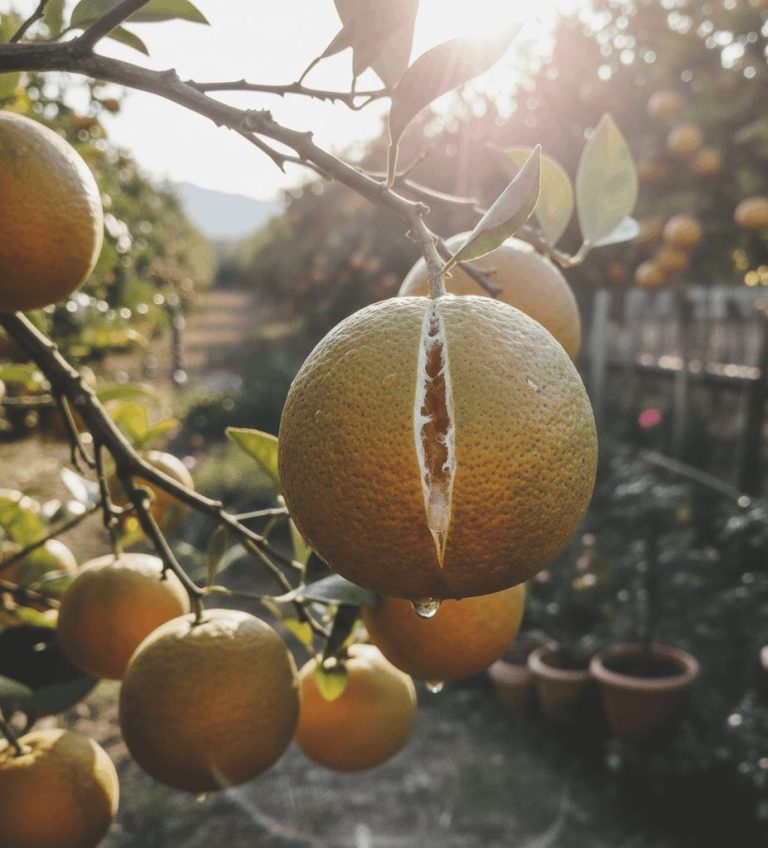
Cover image: AI-generated illustration.