Growing a citrus tree in a pot is the obvious solution when you have no garden, no climate mild enough, or no wish to risk a rare tree in the ground. It is also a discipline of its own: a potted citrus is not managed like a planted one. It depends entirely on watering, potting mix, repotting, and the initial choices of variety and container. Done well, it produces flavorful fruit for several decades, on a Paris balcony as on a Bordeaux terrace. Done badly, it declines within two seasons.
This complete guide covers the 6 key decisions for a potted citrus: choice of variety, choice of pot, potting mix and drainage, watering and fertilizing, overwintering, repotting. It is meant as much for the beginner who wants a first kumquat as for the amateur gardener who wants to widen a collection grown in containers.
Which citrus should you choose for pot culture?
Not all citrus are equal when it comes to pots. Some thrive in a container for decades, others decline within two seasons. Three criteria guide the choice: vigor (a tree that is too vigorous quickly gets cramped in a pot), hardiness (which determines whether the tree can overwinter outdoors), and how early it fruits (trees grafted on Flying Dragon bear from the 2nd or 3rd year).
Which varieties excel in pots?
| Variety | Height in a pot | Hardiness | Special feature |
|---|---|---|---|
| Marumi kumquat | 5 to 6.5 ft (1.5 to 2 m) | 10°F (−12°C) | Compact, hardy, fruits eaten whole |
| Nagami kumquat | 5 to 6.5 ft (1.5 to 2 m) | 14°F (−10°C) | The most widely grown, oval fruits |
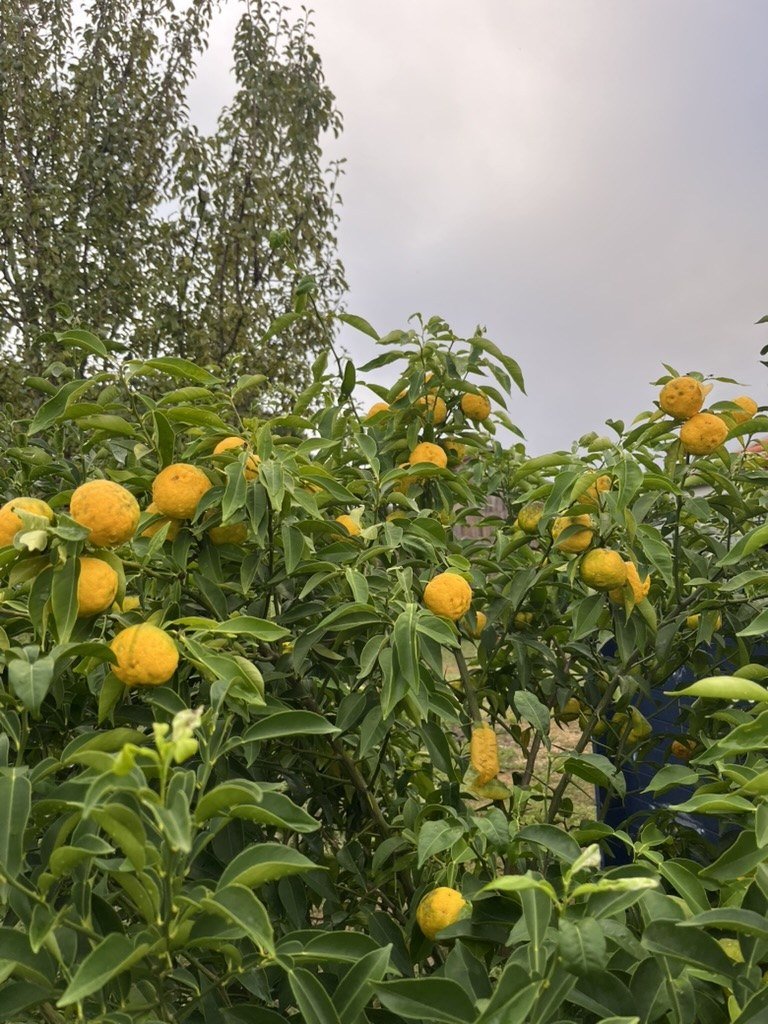
| Hana Yuzu | 6.5 to 8 ft (2 to 2.5 m) | 10°F (−12°C) | The most fragrant in bloom |
| Meyer lemon | 6.5 to 10 ft (2 to 3 m) | 19°F (−7°C) | Continuous fruiting, mild juice |
| Four Seasons lemon | 6.5 to 10 ft (2 to 3 m) | 23°F (−5°C) | Year-round flowering and fruiting |
| Calamondin | 5 to 6.5 ft (1.5 to 2 m) | 25°F (−4°C) | Ornamental, tart fruits for jam |
| Iwasaki satsuma mandarin | 6.5 to 10 ft (2 to 3 m) | 10°F (−12°C) | Early, seedless, weeping habit |
| Yuzu N°3 | 8 to 11.5 ft (2.5 to 3.5 m) | 1°F (−17°C) | More vigorous, an expert’s choice |
For a beginner, the Marumi Kumquat or the Meyer Lemon remain the safest bets: compact, productive, and undemanding. For a more aromatic approach, the Hana Yuzu or a Sudachi bring unique flavors to the kitchen. See the complete inventory of 170+ varieties to explore all the options.
Should you favor a particular rootstock?
Yes, and it is probably the most important decision. For pot culture, two rootstocks dominate:
- Flying Dragon (Poncirus trifoliata var. monstrosa): a dwarfing form of Poncirus that naturally limits the tree’s height to 6.5 to 10 ft (2 to 3 m) and speeds up fruiting from the 2nd or 3rd year. It is the king of rootstocks for container growing.
- Standard Poncirus trifoliata: more vigorous but less compact, ideal for very large containers of over 26 gal (100 L) or for those who want a more imposing tree.
The classic Mediterranean rootstocks (Volkameriana, Rough Lemon, Carrizo citrange) are best avoided in pots: too vigorous, they fill the container in 2 to 3 years and require frequent repotting.
Which pot should you choose for your citrus?
What pot size should you plan for?
The simple rule: the pot’s diameter should be close to the diameter of the young tree’s crown, and increase with each repotting. For a citrus bought in a nursery pot of 2 to 2.5 gal (7 to 10 L):
- First repotting (1 year after purchase): a pot of 7 to 9 gal (25 to 35 L), about 14 to 16 in (35 to 40 cm) in diameter.
- Second repotting (3 to 4 years after purchase): a pot of 10 to 16 gal (40 to 60 L), 18 to 22 in (45 to 55 cm) in diameter.
- Final-size pot (from 5 to 6 years on): 21 to 26 gal (80 to 100 L), 24 to 28 in (60 to 70 cm) in diameter. This is generally the final size for a mature potted citrus.
Going too big all at once is a classic mistake: the excess potting mix stays wet and suffocates the roots. Going up one size at each repotting gives better results.
Which material should you favor?
- Terracotta: lets the roots breathe, regulates moisture better, looks good. Drawback: heavy and fragile in frost, and it can burst at 23°F (−5°C). Preferred by experienced gardeners.
- Wood (orangery boxes): excellent thermal insulation, classic look, lasts 10 to 15 years. The premium choice, and more expensive.
- Thick plastic: light, frost-resistant, inexpensive. Acceptable, but it encourages sudden swings in moisture (dry in the sun, soaked after rain).
- To avoid: glazed pots without ventilation, metal containers (they heat up in the sun), black pots (summer overheating).
Every pot must have at least one drainage hole in the bottom (ideally several) and be raised on wedges or feet to prevent water from stagnating under the container.
What potting mix and drainage should you plan for?
Why is a “citrus” mix so critical?
A standard garden-center potting mix is often too rich in peat and too compacting for citrus, which require a substrate that is free-draining, slightly acidic (pH 6 to 6.5), and well structured to let water and air reach the roots.
Recommended composition for a homemade mix:
– 40% Mediterranean-plant potting mix or special citrus mix
– 25% garden soil (adds mineral content and structure)
– 20% perlite or fine lava rock (drainage)
– 15% ripe compost or leaf mold (stable organic matter)
A layer of expanded clay pellets or lava rock 2 to 3 in (5 to 8 cm) deep at the bottom of the pot greatly improves drainage and remains essential to prevent root suffocation.
Should you mulch the surface?
Yes, always. A mulch of about 1 in (2 to 3 cm) on the surface (pine chips, ramial chipped wood, pine bark):
– Limits summer evaporation (saves 30 to 40% of the water).
– Stabilizes the substrate’s temperature (cool in summer, less prone to freezing in winter).
– Gradually acidifies the soil, which suits citrus perfectly.
– Improves the look of the pot.
Renew the mulch every spring when repotting or applying fertilizer.
How do you water and fertilize a potted citrus?
How often should you water?
Watering is by far the number one cause of death for potted citrus. Too much water causes root suffocation (uniform yellowing, massive leaf drop), too little causes water stress and flower drop. The rule: water when the top 1 in (3 cm) of the substrate is dry, never on a fixed schedule.
Indicative targets by season:
– Spring (April-May): 1 to 2 times a week depending on exposure.
– Summer (June-August): every 2 to 3 days, sometimes daily in full sun and high heat.
– Fall (September-November): once a week, gradually slowing down.
– Winter (December-March): only once every 10 to 15 days, just enough to keep the substrate from drying out completely.
Always water generously (until you see water running out of the drainage holes), then wait until the top 1 in (3 cm) has dried before the next time. Shallow, frequent waterings encourage surface rooting that is sensitive to drought.
What water should you use?
Tap water in limestone regions (half of France) is loaded with lime and chlorine, aggravating factors for iron chlorosis. Favor:
– Collected rainwater (the best, with a naturally acidic pH).
– Water filtered through charcoal or reverse osmosis.
– Failing that, tap water left 24 hours in open air to let the chlorine evaporate.
How should you fertilize?
A potted citrus depends on fertilizer: its limited substrate runs out quickly. Indicative program:
- April: first application of a citrus-special NPK fertilizer (typical formula 12-6-6 or 15-10-15) at the dose the manufacturer indicates.
- June: second application, slightly reduced.
- September: last application of the season, then stop: fertilizer after September stimulates tender shoots that will freeze in winter.
- Winter: no application.
Slow-release fertilizers (sticks, coated granules) simplify the schedule but cost more. An organic application (dried blood, horn meal) in early spring complements mineral fertilizer well and feeds the substrate’s microbiology.
How do you overwinter a potted citrus?
Should you bring your citrus indoors for winter?
It all depends on the variety’s hardiness and your climate zone. The rule:
- USDA zone 9 (Côte d’Azur, Roussillon): most potted citrus can stay outside all year, with a P30 winter fleece over the canopy when frost below 28°F (−2°C) is forecast.
- Zone 8 (Southwest, Atlantic coast): hardy varieties (kumquats, yuzus, satsumas) can stay outside with fleece and a generous mulch. Less hardy varieties (Meyer, calamondin) should be sheltered in an unheated sunroom or a frost-free greenhouse.
- Zone 7 (Center, inland Brittany, Lyon area): getting the citrus out of severe frost is mandatory. Solutions: an unheated sunroom, a cold greenhouse, a bright garage, or a cool indoor spot near a window at 46 to 59°F (8 to 15°C).
What mistakes should you avoid when overwintering?
- Bringing it into a room that is too warm, above 64°F (18°C): the citrus keeps growing, weakens, and drops its leaves. Target: 41 to 54°F (5 to 12°C) for ideal overwintering.
- Lack of light: an overwintering citrus must keep natural light. A dark cellar is fatal.
- Too much winter watering: a citrus that is not warm uses almost no water. Water just enough to avoid extreme dryness of the substrate (once every 10 to 15 days is enough).
- Setting it out too early in spring: a return of frost on a tree that has started to bud can do more damage than the whole previous winter. See our guide to coming out of overwintering for the zone-by-zone calendar.
For detailed frost protection techniques (fleece, heating cable, mulch), see our complete guide to the 9 protection techniques.
When and how do you repot a citrus?
How often should you repot?
- Every 2 years for young trees (1 to 5 years old) in pots of 4 to 10 gal (15 to 40 L).
- Every 3 to 4 years for adult trees in pots of 16 to 26 gal (60 to 100 L).
- Every 5 to 6 years or more for very large trees in orangery boxes.
Urgent signs that a repotting is needed: roots coming out of the drainage holes, water that no longer soaks in (the substrate is compacted), visible stagnation of growth despite correct watering and fertilizing, chronic yellowing not corrected by feeding.
What is the right time?
March-April, before the new growth starts but after the last hard frosts. Absolutely avoid summer (heat stress) and fall (the tree does not have time to heal its roots before winter).
How do you go about it?
- Prepare the new pot: a drainage layer 2 to 3 in (5 to 8 cm) deep (expanded clay pellets, lava rock), then a first layer of fresh potting mix.
- Gently take the root ball out of the old pot. If it is hard, tap the sides or cut the plastic pot.
- Examine the roots: cut off dead roots (black, soft) with clean pruners. Lightly loosen the roots on the outside of the root ball if it has spiraled.
- Position it in the new pot: the root collar should sit 1 in (2 to 3 cm) below the pot’s rim, never buried deeper.
- Fill in with fresh potting mix, firming lightly without compacting.
- Water generously the first time to hydrate well. In the following weeks: measured watering until growth visibly resumes.
- No fertilizer for 4 to 6 weeks after repotting (the roots are fragile, and fertilizer would burn them).
The 5 most common mistakes in container growing
- Choosing a rootstock that is too vigorous (Volkameriana, Rough Lemon) that fills the pot in 2 years → prefer Flying Dragon or Poncirus.
- Watering too much or too little → check the dryness of the top 1 in (3 cm) of the substrate before each watering.
- Bringing it into a room heated to 68°F (20°C) → the citrus wears itself out. Target 41 to 54°F (5 to 12°C) for overwintering.
- Skipping repotting for 5+ years → compacted roots, and the tree slowly declines.
- Fertilizing after September → tender shoots killed by the first frost.
To understand the warning signs (yellowing, leaf drop, abnormal fruiting), see our complete guide to the causes of yellowing citrus leaves.
In summary
A well-managed potted citrus produces for decades. The fundamentals to remember:
- A compact variety on a Flying Dragon rootstock or Poncirus.
- A free-draining pot that gets progressively larger at each repotting, never oversized all at once.
- Acidified, free-draining potting mix + a drainage layer at the bottom + surface mulch.
- Regulated watering based on the substrate’s actual dryness, not a schedule.
- NPK fertilizing from April to September, never after.
- Overwintering suited to the zone: outside with fleece in zones 8-9, in an unheated shelter in zone 7.
- Repotting every 2 to 4 years in spring.
Pot culture opens the horizon of citrus to every gardener, whatever the climate and the space available. To explore the varieties suited to your zone and your uses, browse our complete filterable inventory or our ranking of the 15 hardiest citrus to identify the variety that suits you.
Cover image: AI-generated illustration.