Identity
History & Description
Origin
The Jokan Grapefruit is an old Japanese citrus, a natural hybrid between a pummelo (Citrus maxima) and a mandarin, traditionally grown in the southern prefectures of the archipelago, where its winter keeping qualities and hardiness made it a fruit appreciated by farmers and collectors. Its Japanese name evokes the term "jokan", sometimes translated as "winter castle", in reference to the fruit's ability to stay on the tree all winter without deteriorating. Like many Japanese citrus arising from ancient natural crosses, Jokan benefits from a composite genetic lineage that combines the sweetness and generous size of the pummelo with the aromatic finesse and hardiness inherited from its mandarin parents. Obscure outside Japan for decades, the Jokan Grapefruit was recently introduced to France by Pépinière du Bosc, where its hardiness, exceptional for a grapefruit, down to 7°F (−14°C), makes it a sought-after botanical curiosity for lovers of hardy citrus. Its position midway between mandarin and pummelo also makes it one of the few "sweet grapefruits" available in France, without the bitterness characteristic of the parent species Citrus maxima.Tree description
The Jokan Grapefruit forms a vigorous, highly productive tree of 10 to 13 ft (3 to 4 m) at maturity, with an upright habit and dense, glossy evergreen foliage. Its growth is fast and steady, and the tree comes into generous production from its fifth year on FA5 rootstock. The spring white blossom is fragrant and abundant. Its hardiness reaches 7°F (−14°C) for a well-established adult tree, a feat that places it among the most cold-resistant grapefruits ever marketed, suited to the northernmost zone 7b areas of France.Fruit quality
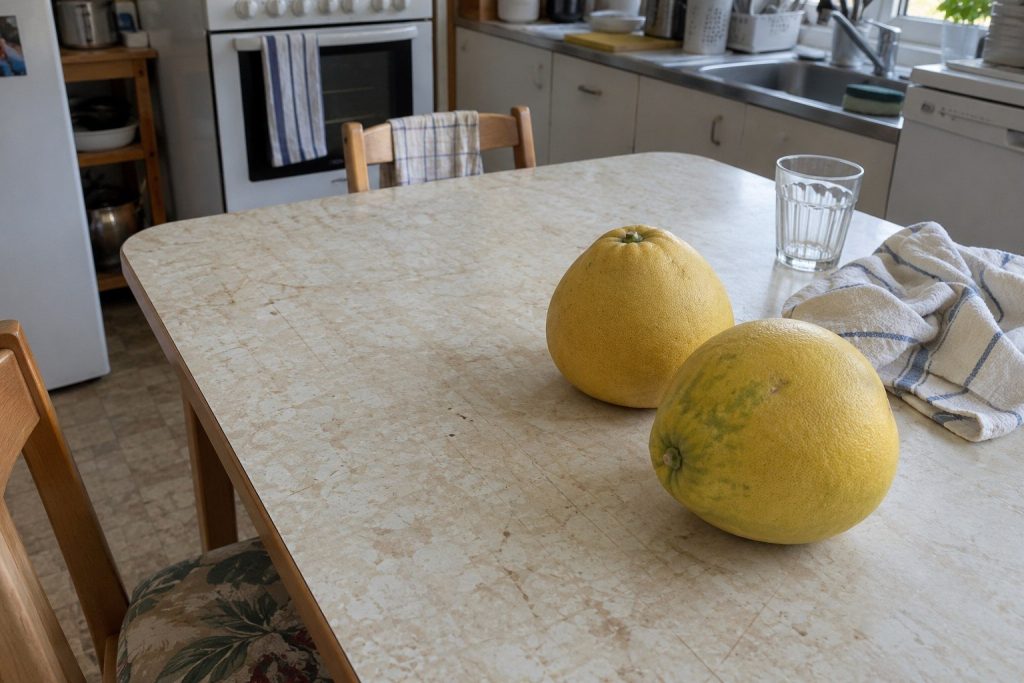
The fruits, medium to large, have a characteristic pear shape and smooth skin turning from golden yellow to orange at full maturity. The pale yellow to very tender pink flesh stands out for its remarkable juiciness and its perfect balance between sugar and acidity, completely free of the bitterness typical of grapefruits. The flavor falls midway between mandarin and pummelo, with delicate floral notes and a long, fragrant finish. Seeds are few.Flavor and ornamental interest
Harvested between December and March, Jokan is ideally eaten fresh, to appreciate its melting texture and balanced sweetness. Its abundant, aromatic juice suits sophisticated cocktails, mixed juices, and even marmalades, where its lack of bitterness gives a more accessible result than classic grapefruit marmalades. As an ornamental, the tree offers remarkable landscape interest in winter, its large pear-shaped yellow-orange fruits persisting for several months on the branches, creating a striking visual effect in a hardy-citrus garden.Updated:
What matters when choosing
Key points about Jokan Grapefruit
Jokan is an old Japanese name associated with the Citrus obovoidea group, where it also appears as a synonym of Kinkoji. Its large, sweet-tart fruit can resemble a pummelo with little bitterness, but extreme hardiness claims and its status as a separate cultivar are insufficiently documented.
Why choose it
- Large, juicy fruit, generally with little bitterness.
- Flavor profile between mandarin and pummelo.
- Thick zest usable for processing.
Its limits
- Jokan may be a synonym rather than a distinct cultivar.
- Thick peel and some seeds are possible.
- Cultivar-specific cold hardiness has not been demonstrated.
Practical notes
- Group
- Citrus obovoidea
- Associated synonym
- Kinkoji
- Uses
- Fresh fruit and processing
Cold-hardiness reference: about 7°F (−14°C)
The nursery-reported reference has not been confirmed by any independent trial found; it is not a guarantee of survival or harvest.
Sources and method
The temperatures given are reference points for a mature tree with hardened wood. The table and callout repeat the same value as the profile. They guarantee neither freedom from damage nor a harvest after a freezing event.
Data reviewed on September 21, 2026.
- Generalitat Valenciana — citrus nomenclature — Jokan as a synonym in the Citrus obovoidea group
- Citrus ID — Kinkoji — Group morphology, peel, and flavor
- Pépinière du Bosc — Jokan — Description of the commercial clone distributed as Jokan